Honest process map
A clear picture of how work actually runs, what outcomes matter, and which agents, models, and usage paths create risk or waste.
Mayordomo's flagship AI engagement for UK teams with a stalled or failed build: match failure patterns, run a fixed seven-step recover-and-realign method, and leave a maintainable baseline your engineers own without needing us forever.
Hands-on in the code and delivery system. Free recovery discussion first, then fixed-scope work. We leave when your team owns the platform, not when a retainer becomes comfortable.
Founder-led senior delivery. Fixed scope. Ownership left with your team.
AI-assisted delivery often produces systems that look complete in demos but fail under real ownership: unclear boundaries, missing tests, secrets only one person understands, and no safe path to production.
Teams face a false choice: abandon the work, or pour more spend into the same approach. There is a third path: recover what is live, re-fit it to real needs, and leave a maintainable baseline your team can own.
Work in your repository and pipeline, not a slide deck. Outcomes the seven-step process leaves behind.
A clear picture of how work actually runs, what outcomes matter, and which agents, models, and usage paths create risk or waste.
Unsafe tools, spend, and production-critical flows frozen or constrained so change is safe before new pipelines go in.
Workflows with roles, handoffs, and failure paths that replace ad-hoc prompts, plus token and performance tuning once structure exists.
Quality, cost, and policy signals; evals for regression; runbooks and exit criteria so your engineers own the baseline after we leave.
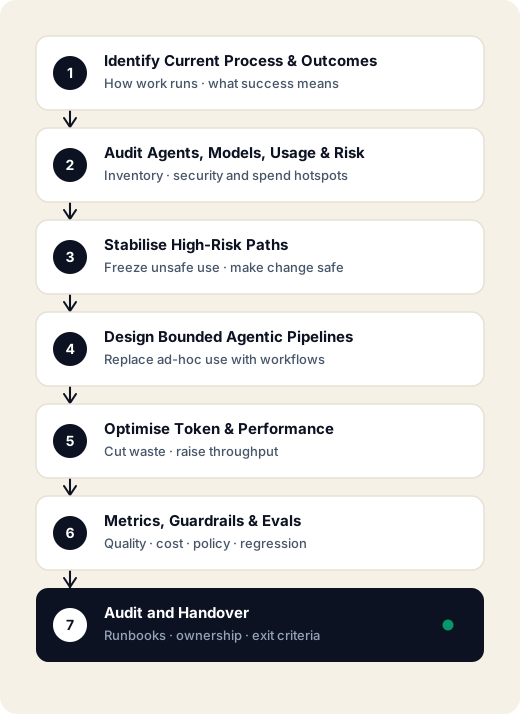
A fixed seven-step process for agentic and multi-model setups that fail under real use. We map the work, audit the stack, stabilise risk before building, then optimise and control so the exit is ownership, not another black box.
Engineering that holds up in production.
How work actually runs today, and what success means for the business.
Inventory tools, models, and spend; surface security and ownership hotspots.
Freeze unsafe use and production-critical flows so change is safe again.
Replace ad-hoc prompts with workflows that have roles, handoffs, and failure paths.
Cut waste and raise throughput once structure exists, not before.
Quality, cost, and policy signals; regression checks that hold under real traffic.
Prove clearance, leave runbooks and exit criteria, ownership with your staff.
We start with what is live: process, agents, models, usage, and risk, not a greenfield fantasy. Until the real work and the real stack are mapped, pipeline work is guesswork. Steps 1 and 2 give an honest salvage-vs-rewrite-vs-retire read before anything new is built.
High-risk paths freeze before new agentic work lands. Then we design bounded pipelines that replace ad-hoc tool use, so the system matches how the business actually works, not the chat history that built it.
Token and performance work comes after structure. Metrics, guardrails, and evals make failure modes visible. Handover is the exit: runbooks, uplift, and a baseline your staff can run under real traffic. Full commercial recovery scope is this engagement: free discussion, fixed-scope stabilisation, handback.
AI-assisted delivery often accelerates output until the system hits production reality. If one of these looks familiar, there is usually a path through.
Browse the full pattern hub, or open a card below.
Marketing sites and product MVPs spun up with AI look finished in a weekend, until SEO, accessibility, and changeability fail under real traffic.
Growing businesses ship features faster than they can hire. Ownership concentrates, and the product becomes hard to hand over or scale safely.
Quick AI-built code optimises for “it runs” over readability, tests, and design. Sprawl grows until every change is risky.
AI spend shows up twice: token and tool bills during build, then cloud and rework cost in production.
Models produce auth and crypto code that looks professional and is subtly wrong until production or audit.
Each AI session optimises the local problem. Over weeks, the system becomes a collage of styles and boundaries.
AI-generated trading, payments, and ledger code often works in demos and collapses under real load, concurrency, and audit.
Enterprise AI experiments skip tenancy, identity, audit, and data boundaries until a pilot must become a real service.
Send the stalled system outline, stack, symptoms, and timeline. Robert replies with an honest engineering read. Free, no obligation.
Or email info@mayordomo.co.uk with a short outline.